

Yes, if your supplier accepts the split for your fabric and print method. An even order is 75 bandanas per Pantone color, not 300 per color. Before you pay, get a written quote that confirms the quantity for each color, any extra charges, and the delivery date for the full order.
How to split the 300 pieces
| Item | Even split | Uneven example |
|---|---|---|
| Pieces per color | 75 / 75 / 75 / 75 | 100 / 100 / 50 / 50 |
| Share of the order | 25% each | 33.3% / 33.3% / 16.7% / 16.7% |
| Total pieces | 300 | 300 |
Ask whether the minimum applies to the whole order or to each version. For example, if the quote requires 75 per color, the even split meets that minimum but the two 50-piece batches do not. At that minimum, 75 per color is the only four-color split that stays at 300. If you need 100 each of the two main colors, keeping those counts and bringing the other two up to 75 takes the order to 350. If 300 is a hard cap, ask whether the 50-piece batches can be quoted as exceptions; if not, rebalance the counts or drop a color. The 75-piece minimum is hypothetical, not a 4inBandana policy.
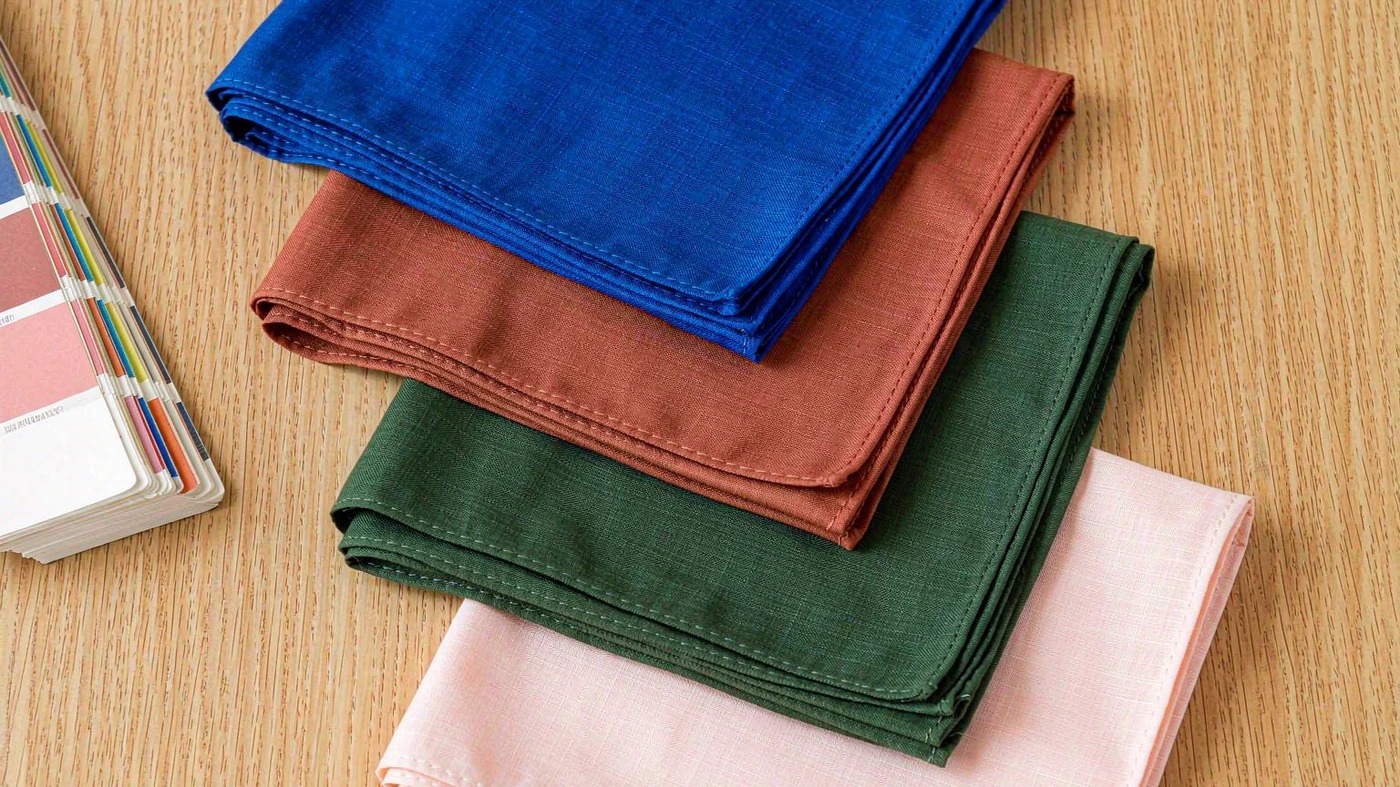
Are the Pantone colors for the fabric or the logo?
Tell the supplier which part of each bandana must match the Pantone reference:
- Four backgrounds, one logo color: Ask whether each target shade can be sourced on the same fabric or needs to be printed as part of the design. For example, “navy background, white logo” tells the supplier which shade to match and which artwork to keep unchanged.
- One background, four logo colors: Specify that each version uses just one of the four logo colors. Otherwise, “four-color logo” can be read as four colors in the same artwork.
- Both change: Pair the background and logo references on each quantity line so the supplier can quote and proof the right combinations.
For screen printing on bandanas, ask whether the printer can reuse the same screen when the artwork stays the same, and what it charges for ink changes or separate setups. Four color options alone do not tell you how many screens are needed. If the supplier proposes digital printing or heat transfer, ask how it will reproduce the target shades. If the design is embroidered instead, ask for thread swatches.
How to approve each color before production
Send each full Pantone code, including its suffix, and identify the swatch guide you used. Ask for a digital proof of each version so you can check the artwork, logo placement, and printable area. If you’re ordering a 22 × 22 in square, that’s about 55.9 × 55.9 cm [1]. Confirm that the quote specifies the finished size and its tolerance, not just the cut size.
If the shade is critical, ask for a physical sample of each version whose color you need to approve, made with the fabric and print method you plan to order. For example, if the same white logo goes on navy and pale yellow bandanas, check the white against each background. If the navy shows through the white on the sample and that is not acceptable, ask for a revised sample rather than approving it based on the pale yellow version. Compare opaque fabric samples side by side with the agreed reference under consistent lighting. ASTM D1729 recommends simulated average daylight for general visual color appraisal of diffusely lit opaque materials [2].
Write down which sample is approved for each version and agree on how you will judge the delivered colors. If a shade misses the agreed reference, specify which version needs a revision and whether the other versions may go ahead. Keep that approval record so both sides can refer to the same sample if a delivered batch looks different.
How to compare prices and protect your delivery date
- Compare like-for-like totals. If you want to know what the split adds, ask for two quotes on the same fabric, size, artwork, and delivery destination: one for 300 in a single color and one for the four-color split. Ask each quote to show any setup, color-change, sample, packing, and shipping charges separately, and to say which are included in the total. A lower unit price does not settle the comparison if the two quotes include different charges.
- Work backward from the date you need the full order. Ask when all four versions can arrive and by when proofs or samples must be approved to make that date. If one shade needs a revised sample, ask whether it will hold the full shipment or whether approved colors can ship separately, and at what cost. If you need all four colors for an event, the first shipment date is not enough.
What to put in the quote request
- Quantities and artwork: Use one line per version. For example: “A — 100 pieces; navy background (full Pantone code and guide); white logo; shared logo file.” Repeat for the other three versions and put the total at the bottom. Use the same version labels on proofs and carton labels if you request packing by color.
- Fabric and finish: Specify the fiber blend and fabric weight if they matter to your order, along with the finished size. When comparing custom bandana fabric and style options, confirm the fiber composition rather than relying on a finish name such as satin.
- Delivery and packing: Give the destination and the date by which you need all four colors. If the colors go to different teams or locations, state whether you need separate, labeled packs and in what quantities.
- Care and acceptance: Ask for care instructions for the finished item. If you expect repeated washing, ask whether any available colorfastness results apply to the quoted fabric and decoration under the wash conditions you expect. Agree in writing on what happens if a batch does not match the approved sample under the agreed viewing conditions.
If the bandanas are for U.S. retail sale, confirm with the supplier which labels apply and who will provide them. FTC textile labeling guidance covers fiber content, origin, and business identification for covered goods [3]. The separate Care Labeling Rule covers certain apparel and piece goods and excludes handkerchiefs; confirm how your finished item is classified rather than assuming all bandanas have the same requirement [4].